
How to Strip and Polish Vinyl Flooring
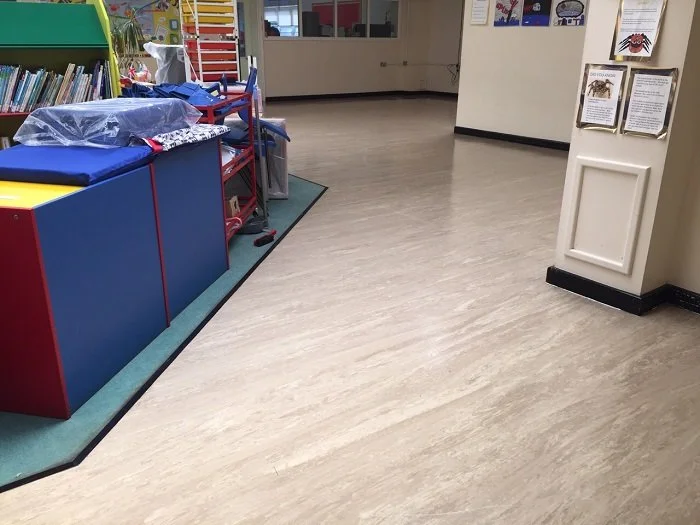
Vinyl Flooring in a School.
Vinyl Flooring
Vinyl flooring in sheet format is a favourite choice for large commercial buildings such as schools and community halls due to its cost, ease of cleaning, maintenance and durability.
Modern Luxury Vinyl Flooring ( LVT) is also very popular, and prominent brands like Karndean and Amtico grace many homes.
Vinyl Floor Cleaning
All types of Vinyl flooring require periodic cleaning and maintenance, such as re-application of the seal or polish to protect the flooring from wear and damage. When vinyl flooring is installed, it’s often sealed to enhance and protect it.
Regular floor cleaning entails sweeping or vacuuming to remove light dust, followed by mopping using a neutral detergent to remove light soiling.
Products
Flooring manufacturers such as Amtico and Karndean produce their own brand products for regular cleaning and stripping off old coatings. They also supply the polish or sealer to finish the floor.
Those products are sold in small quantities and are mainly suitable for home use only. For commercial-sized areas, visit a janitorial store for similar products that offer better value and are available in larger quantities.
Prevent heavy soiling and surface wear.
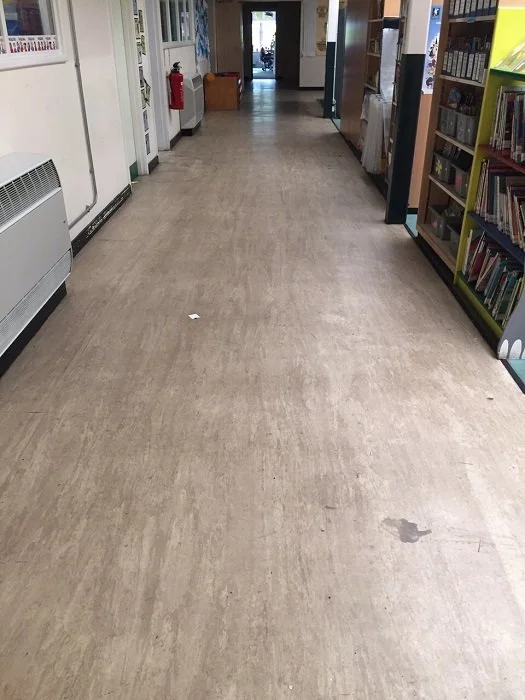
Vinly Floor to be Deep Cleaned
Even with regular cleaning, the surface will eventually wear, and soiling can become trapped in the tiny scratches that appear with everyday use. The seal or polish on the surface eventually breaks down, and a combination of these factors will cause the surface to appear unsightly and worn.
Floor Polish Stripping
It is very important to strip off any existing surface coating before applying a new one. Failure to do this will create problems in the future and ultimately undermine the performance of the applied polish or seal.
If you missed the process during previous maintenance cycles, the task of stripping off the old coatings should be left to a professional floor-cleaning company, as attempts to remove multiple layers of polish or sealant will require industrial cleaning equipment and products.
The first step in removing the old polish is to mix a solution of the chemical (floor polish remover) with water and apply it to the floor. The mixture will usually require at least fifteen minutes to activate before it starts breaking down the surface coating. During this time, it is important to ensure the mixture does not dry out. You can replenish by adding more mixture as required.
The variation in time and effort required for the floor polish stripping process depends on the number of previous coats of polish or sealant to be removed. Most stripping products (floor polish remover) will break down approximately three coats per application. To remove heavy buildup of coatings, you should purchase a heavy-duty floor polish remover. It will break down more coats per application, potentially saving time and labour.
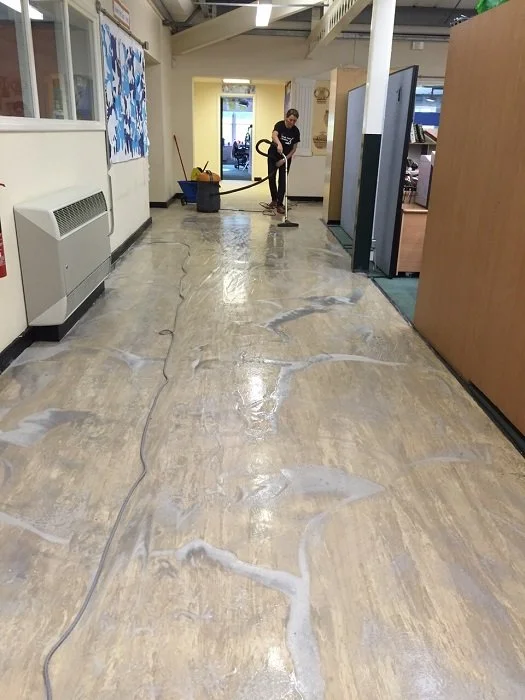
Floor Polish Stripping in a School
Deep Cleaning Vinyl Flooring
Once the surface coating is removed, the vinyl will require deep cleaning to remove soiling and grime that have become embedded and trapped in its worn surface.
Add a cleaning chemical to warm or hot water, then mop it onto the floor surface. The chemicals and hot water will help to break down the soiling; however, the process will also require either manual or mechanical agitation to loosen the embedded soiling.
Agitation with a coarse 3M nylon scouring pad should help. For commercial areas, it is best to use a rotary floor scrubbing machine fitted with a medium or coarse-grade pad.
When the floor is deep-cleaned, it will require mopping or, for commercial tasks, a wet-pickup vacuum to extract the surface slurry and residue. It is good practice to neutralise the floor several times with fresh water to ensure the surface is clean and all chemicals are removed.
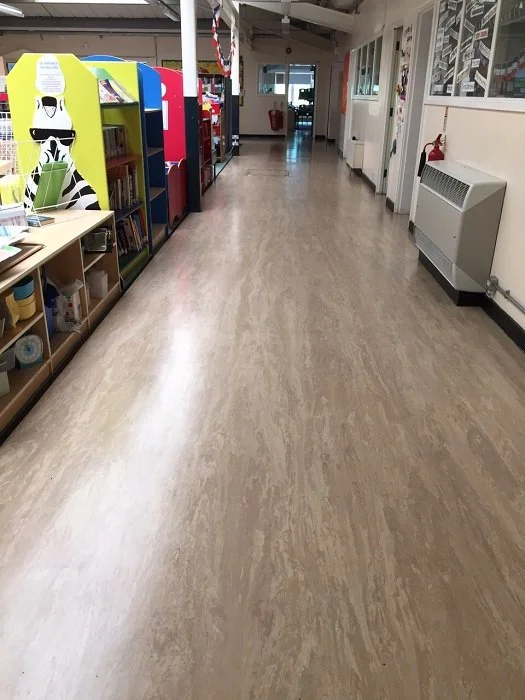
School Vinyl Floor - stripped, deep cleaned and sealed
Vinyl Floor Polish Application Process
Before applying any floor polish, ensure the floor is dry and free of surface contaminants. Pour the floor polish into a receptacle. A professional window-cleaning bucket is a good tool, as most flat mops can easily fit into it.
Pour a little polish into the bucket so the flat mop head can be partly submerged in the polish/seal. Wear rubber gloves to avoid contact with the product and your skin.
Using a fresh, clean, and dry flat mop cover, dip the mop into the polish and then remove any excess polish from the pad by running it along the edge of the bucket. The excess will drain back into the bucket, and the flat mop pad should hold enough polish without dripping all over the floor.
Working left to right across the room ensures the floor is covered evenly with polish. Then, move backwards and work in the opposite direction, right to left. As you work, keep the working edge of the polish constantly wet. As you progress, if you notice a small section has been missed, do not step back onto the damp or drying polish. If you can reach the area without treading on the polish, touch in the missed section with the flat mop; if not, you can cover it with the second coat.
Leave the polish to dry for around half an hour at room temperature before applying a second coat. The second coat should then be applied, working across the direction of the first coat to ensure an even application.
For estimated costs, complete the form.